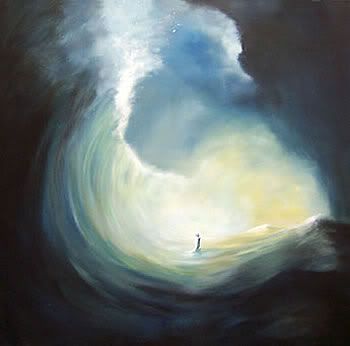
My favorite animal is the salmon. Salmon spend their early life in rivers, and then swim out to sea where they live their adult lives and gain most of their body mass. When they have matured, they return with uncanny precision to the natal river where they were born, and even to the very spawning ground of their birth. This phenomenon is called “salmon run”. Most salmons are anadromous, a term which comes from the Greek
anadromos, meaning "running upward". From ocean they swim and flip and flop and swoosh in waterfalls and streams just to return to their river. All that they want to “go home”. It’s as if the salmon which grew up in the sea has become tired of the sea and its wonders, and at some point of its adult life, when it is at its peak condition, began to follow the voice within and went on the task of swimming against the current and back to where its life has started. No snack breaks, no half-way rests. With single devotion, it swims back. Back to its origin of life. A kind of homecoming. A kind of fulfillment of its purpose.
I have known the Lord from childhood. My mother, a Catholic, raised us in the beautiful traditions of the Church. My father, a Protestant convert, stimulated my aptitude for reasoning. Growing up in a myriad of different rules and living set-ups, with good role models to follow and a handful of people I swore never to be like, I have been exposed to many ideas, often times conflicting, that I need to take and digest, sift and weight. After high school, I followed my mother’s wish for me to try religious life despite my determination to study in University of the Philippines. On 2007, I entered the seminary of Missionary Oblates of Mary Immaculate in Quezon City. A year after, the prefect informed that I could not continue with formation as the seminary is to be transferred in Cotabato City. I went home with angst and regret but Mama assured me that God has plans. Few weeks after, she passed away. It’s thoughtful that she let her eldest son come home first before leaving this world.
At an early age I left home and went to live on my own. I enrolled in University of the Philippines. I have worked in a handful of industries to pay the bills and sustain my lifestyle but it was my entrance to the development sector that made all the difference and impact in my life. I become a humanitarian worker, responding to crises, disasters, and conflicts mostly here in the country. I worked my way through various organizations and have progressed in my career. I worked in at least five major disasters in the region. At 23, I was the youngest in a management role in a large international NGO. At 24, I was already leading a team in Tacloban to respond to the affected populations of typhoon Haiyan. I’ve helped restore livelihoods, schools, bridges, health centers and homes in hundreds of communities. I have slept in tents and service vehicles, eaten Christmas meals on tin cans and celebrated birthdays in airplane, a fishing boat, and a ten-wheeler truck. I have spoken to ambassadors and purok leaders, dined with politicians and communists, and shared ideas with leading thinkers and children with disabilities. Some of the organizations I have been involved are IBON International, ACCORD,
Center for Disaster Preparedness, CARE Nederland, Caritas Philippines, Handicap International, and the Good Shepherd Sisters’ Mission Office.
But God seems to put a vacuum in every man’s heart which only He could fill.
I drove my own car, I lived comfortably, I gained many friends from many parts of the globe. My work and my penchant for adventure brought me to strange cities and villages around the world. For someone who is barely starting to fill to the brim the love for life in a quarter of a century, I suddenly felt there must be something more than these. I was restless.
A turning point in my life was my involvement in the Good Shepherd Sisters’ Mission Office. My work consisted of developing resources and grants for the sisters’ work on human trafficking, women and girls, and ecology. Everyday I see dozens of sisters, most of them in their seventies, all occupied with zeal to do their mission assignment despite meager resources, impossible energy requirement, and advanced age. All their energy is spent in taking care of women and girls and in working towards a more just society. It was June this year, Feast of the Sacred Heart, when I drove to their Tagaytay convent to conduct business even if it was my birthday. I did not want to disturb them in their retreat Mass so I sneaked in and found them in the chapel. About sixty nuns, some of them in wheelchairs, canes, and hearing aids, a sea of white hairs and wobbling knees, taking their time to greet each other with the sign of peace. It was the noisiest group of nuns I have ever seen and it hit me. I want whatever that which makes these women and thousands of other missionaries go on with their ministry despite everything. Right there I gave in to the Lord. I let Him catch me in the middle of my busy life. I did not hesitate and looked for a seminary right away. It was providential that school year in Casiciaco starts on August. I had few weeks to settle my affairs.
In his message to the youth gathered in a university in Rome in 2000, Saint John Paul II concretely describes that restlessness I have been feeling, the feeling that there is a vacuum in my life despite the life I was enjoying:
“It is Jesus in fact that you seek when you dream of happiness; he is waiting for you when nothing else you find satisfies you; he is the beauty to which you are so attracted; it is he who provokes you with that thirst for fullness that will not let you settle for compromise; it is he who urges you to shed the masks of a false life; it is he who reads in your hearts your most genuine choices, the choices that others try to stifle. It is Jesus who stirs in you the desire to do something great with your lives, the will to follow an ideal, the refusal to allow yourselves to be grounded down by mediocrity, the courage to commit yourselves humbly and patiently to improving yourselves and society, making the world more human and more fraternal.”
Salmon run teaches something profound to me. Salmons that survive fishermen, poachers and pollution may still have to scale large dams built across rivers before eventually finding refuge in lakes and deep pools. Nevertheless they go. Some studies reveal that some very strong willed salmon even do it more than once in their lifetime. A life in religious formation, a life dedicated to discovering God’s purpose to me, is my own salmon run. While the salmon had to survive impossible ordeals, my challenge is not simply to survive but to thrive in the formation. To thrive means to find meaning in every detail of my life’s up and downs, to discover hidden lines of God’s love story in every pitfalls and trials, to search the poetry concealed in people I meet and places I go. To thrive does not only mean to remain alive after successive challenges in formation. To thrive means to grow vigorously in the process.
Nine years after my first attempt to try religious life, here I am again in the bottom of the formation process. Late that I realized that my mother’s wish has always been the life I, too, want. Often I would feel undeserving, or caught by temporal problems at home but I trust that the true, good, and beautiful God would allow me to try again one more time. That this time, despite numerous imperfections He can find something in me to use. That my scattered thoughts may find unity in His love, my doubts may find certainty in His truths, my depravities may find mercy in His goodness, and my deficiencies may find completeness in His beauty.